OGC Newsletter - June 2001
CONTENTS
Presidents Message
News From the Nashua Meeting
On Standards
On Documentation
OGC Specifications
Contracts and Implementations
Interoperability Program
Member Corner
New Members
OGC In The News
Events
Contact
Subscribe/UnsubscribeBack issues of OGC News are available.
![]() |
PRESIDENTS MESSAGE
GSDI, Digital Earth, ANVIL, GINIE, Aurora, the Geodata Alliance, Gateway to the Earth, Earth Science Enterprise The list of emerging geospatial infrastructure initiatives grows longer each year. So does the list of less known initiatives that are under way in many, perhaps most, countries, regions, provinces, counties and cities. Each of these activities advances local, national and international sharing of spatial data.
OGC plays a unique role supporting a number of these initiatives. Working with GIS and IS vendors, data suppliers, and user organizations, OGC has spent over seven years developing open geoprocessing interfaces and protocols. OGC's members have removed much of the old geoprocessing Tower of Babel and constructed in its place a system of interface specifications that enable one software vendor's geoprocessing software to talk to another's over the web (or other networks).
We are pleased that many of our consensus-derived technical interoperability specifications form a framework for documents such as the GSDI Cookbook, the Digital Earth Reference Model, geospatial initiative white papers, and software procurement requirements. The weaving of OGC's standards into each effort is a prerequisite for future data sharing and helps to ensure a true global solution. Data coordination, or adherence to semantic standards in naming features and creating metadata, is also imperative, and OGC's Information Community Enablement work includes plans to make this kind of coordination much easier.
Another, less obvious benefit of the OGC process is that OGC's "open specifications" allow new, cutting edge technologies to have a place in initiatives such as the GSDI. OGC's interaction with SDI groups in this way provides a two-way interaction. On the one hand we need these groups to provide new requirements and development challenges, as well as guidance in the development of interoperability approaches. While on the other hand, we seek formal cooperation that layers our specification development activities, largely driven by the new technology approaches drawn to the consortium process, into SDI development activities. And the truly creative, virtually endless opportunity that results is the consortium's open door, which serves as a constant invitation to development companies both large and small to participate fully in the OGC process.
David Schell, President, Open GIS Consortium
GSDI
http://www.gdsi.org/
![]() |
NEWS FROM THE NASHUA MEETING
The June Technical and Planning Committee meetings were hosted by Oracle in Nashua, NH earlier this month.
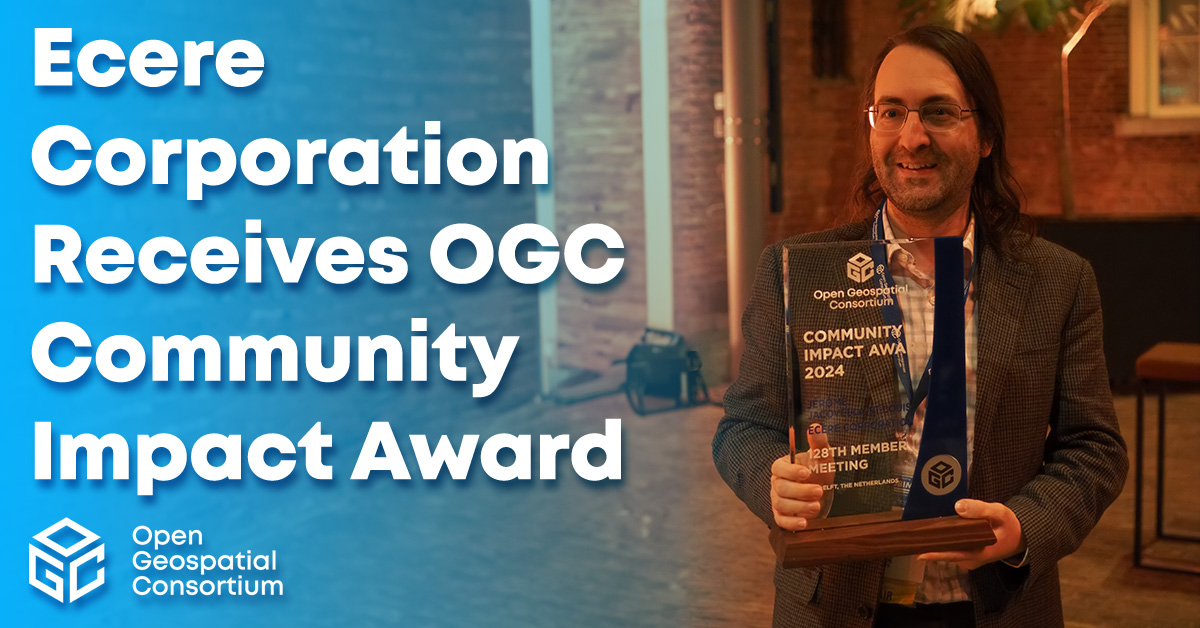
One highlight was the presentation of this year's Kenn Gardels award to Arliss Whiteside of BAE SYSTEMS Mission Solutions. The gold medal is awarded to individuals who have made an outstanding contribution to advance the vision of the OGC. Mr. Whiteside's daughter was present for the award presentation, which noted his exceptional level of commitment, leadership and technical contributions to OGC, including work on image geometry models, accuracy metadata, services architecture, and catalog services. The presentation also fondly remembered Kenn Gardels, one of the founding directors of OGC who passed away in 1999.
The Technical Committee activities touched many areas. Sam Bacharach addressed conformance testing, laying out a plan and presenting a call for participation. The plan includes three flavors of testing: self-testing, OGC staff testing and cross member testing. This Call for Participation is now available at: http://www.opengeospatial.org/techno/conformance.htm. Submissions are due by 2 July 2001.
The Coordinate Transformation Working Group and the TC approved the Units of Measure Recommendation paper as a new Discussion Paper. The Decision Support Special Interest Group (SIG) has begun revising the Geocode, Geoparse, and Gazetteer discussion papers for the next meeting.
The GML SIG is working on an interim alignment release to merge comments from World Wide Web Consortium (W3C). The Open Location Services (OpenLS) Call for Participation is on schedule for mid to late June. The Natural Resources SIG passed its charter and is growing in numbers and interest. Several OGC specs will soon be Draft International Standards (DIS) issued by the International Organization for Standards (ISO), placing them in line to become International Standards this fall or winter. The OLE/COM Simple Features Specification is being formatted for submission to ISO. The Web Map Server Specification is targeted for submission as a proposed committee draft to ISO.
Tom Strickland of Byers Engineering stepped down as chair of the Telecommunications (Telco) SIG. He also stepped down as Technical Committee Representative to the Planning Committee. Kurt Buehler serves as the interim Telco SIG chair; a new chair will be elected at the next meeting. Ron Lake, of Galdos Systems, was elected to the role of Technical Committee Representative to the Planning Committee.
Of particular interest to members, there has been a change in the Geometry RFP dates. Due to a change in the date of the September meeting, Letters of Intent are due August 10, with first submissions due September 10.
![]() |
ON STANDARDS
If, today, different geographic information systems (GIS), web based geoprocessing, and wireless location services automatically shared information and services with each other, there would be little need for additional standards, or for the OGC. But they don't. That's why OGC and many other standards organizations exist. There are a number of ways to look at standards and standards organizations. This month, I want to highlight one difference between the OGC and Organization for International Standards (ISO) Technical Committee 211 on Geographic Information/Geomatics (ISO/TC211). The purpose of the ISO/TC211 committee is to develop mature concepts for GIS components.
The "first generation" GIS standards being created within ISO/TC211 are, for the most part, written at an "abstract specification" level. It is the goal of an ISO/TC211 standard to communicate, in ordinary human language, the objects, relationships, behaviors, and attributes associated with the particular component at hand. These are broad stroke standards, not "this is how we are going to it" standards.
OGC's mission is to deliver spatial interface specifications that are openly available for global use and that can be implemented in products. OGC manages both an Abstract Specification and a growing suite of Implementation Specifications.
Implementation Specifications are written for the software engineer, with the intention of defining precisely how far, and in what way, components conforming to an Implementation Specification will interoperate. It is the objective of an Implementation Specification to be so complete, and so precise, that if two different software engineers write conforming components independently of each other, their components would not only "work" together, but also be "plug and play" for each other in the context of a complete system.
So, clearly the roles of ISO and OGC are different and complementary: OGC's focus is on implementations and on market development; ISO TC211's focus is on professionalism and abstract component definition.
In the coming months we'll have a look at other standards organizations that play a role in geospatial interoperability including The Object Management Group (OMG), The British Standards Institute (BSI), the American National Standards Institute/National Committee for Information Technology Standards (ANSI/NCITS) and many others. Standards don't live in a vacuum and neither do standards organizations.
Cliff Kottman, VP and Chief Scientist, Open GIS Consortium
OGC Specifications
http://www.opengeospatial.org/specs/specs.htm
ISO/TC211
http://www.statkart.no/isotc211/pow.htm
ANSI/NCITS
http://www.ncits.org/
![]() |
ON DOCUMENTATION
The technical foundation of the OGC specification development process is the Abstract Specification. The membership collaborated for close to three years to define the first version of the OGC Abstract Specification. The Abstract Specification is the model to which OGC implementation specifications are referenced. It provides a common language.
About 12 months ago, we realized that we had not adequately maintained the Abstract Specification. Pieces of the model were missing, it did not reflect current market realities and technologies, and it was not harmonized with emerging interface specifications or with various ISO TC/211 efforts.
herefore, we formed a Document Subcommittee. Known as the DocTeam, it considered and evaluated the current state of the Abstract Specification, which in turn, led to consideration of much of the OGC documentation and the documentation process.
DocTeam discussions culminated in a number of actions and recommendations at the OGC Nashua TC meetings.
We created a proposed mission statement for the Document Sub-Committee: The purpose of the Documentation Sub- Committee is establishing and sustaining the harmonized OpenGIS model and ensuring that OpenGIS specs are developed and modified in a manner which is consistent with this harmonized model.
There was unanimous reaffirmation by the Planning Committee of the importance of the Abstract Specification to the OGC, our membership, and the specification development process.
We reached agreement to use more formal documentation outlines/templates and terms and definitions, and agreed to put more effort into identifying inconsistencies between an implementation specification and the Abstract Specification.
We agreed to maintain a strong linkage between the Implementation Specs and the Abstract Spec with the goal of maintaining a core model upon which all OGC specifications and specification development activities are based. The DocTeam volunteered to provide guidance and resources to help achieve the mission and objectives of the Document Subcommittee. The OGC Staff also recognized the need to apply resources to help with these efforts. Therefore, Kris Kolodziej has been brought on as a resource to help write UML for the Abstract Specification. The OGC staff is also exploring additional resources, and plans to identify them at the next Technical Committee meeting, if possible.
Carl Reed, Director of Specification Programs, Open GIS Consortium
![]() |
OGC SPECIFICATIONS
A revised version of the Web Map Server specification, revision 1.1.0 was passed and is available at:
http://www.opengeospatial.org/specs/specs.htm
A new discussion paper, Units of Measure and Quantity Datatypes, passed and is available at:
http://www.opengeospatial.org/specs/discussions.htm
Details of the specifications
http://www.opengeospatial.org/specs/specs.htm
Specifications
http://www.opengeospatial.org/specs/specs.htm
![]() |
CONTRACTS AND IMPLEMENTATIONS
Trimble has included access to data stored in products that implement OpenGIS Specifications in its latest Pathfinder data collection software. When run on a handheld, layers can be captured via a wireless Internet connection to serve as background reference for GPS data capture.
Press Release
http://www.trimble.com/press/presrel/061501a.htm
![]() |
INTEROPERABILITY PROGRAM
The Interoperability Program (IP) is a global, collaborative, hands-on engineering and testing program designed to deliver proven candidate specifications into OGC's Specification Development Program.
There is a great deal of activity in the Interoperability Program this month:
An OGC Network (OGCN) initiative has begun. The first step, the development of an OGCN architecture, is underway.
The Open Location Services (OpenLS) Request for Quotation (RFQ) is being developed and will be available for review on the OpenLS site soon (www.openls.org)
The Interoperability Program integrators program, which aims to make it easier for technology integration organizations to partner with OGC, is being finalized.
Sponsors of the OGC Web Services Initiative met on June 6 in Nashua, NH, and on June 22 in Rosslyn, VA to discuss the industry responses received as a result of the recent Request for Technology. Sponsors agreed on an initial prioritization of the major interfaces and associated technologies to be funded, and addressed the remaining issues regarding the formalization of this initiative. Current sponsors include: Natural Resources Canada, the US Army Corps of Engineers Engineering Research and Development Center (ERDC), the Environmental Protection Agency, the US Geological Survey, NASA, Lockheed Martin, Logicon TASC, In-Q-Tel and the Federal Geographic Data Committee.
Organizations interested in sponsorship or participation in the interoperability Program may contact Jeff Harrison, Director of the OGC Interoperability Program (703) 628- 8655.
Interoperability Program
http://www.opengeospatial.org/interop00.htm
![]() |
MEMBER CORNER
Ordnance Survey, Britain's National Mapping Agency, is showing its commitment to the ideals of the Open GIS Consortium by announcing that its core spatial data will be supplied in the Geography Markup Language (GML) beginning in November 2001. Ordnance Survey has been a member of the OGC Technical Committee (TC) since 1998, sending representatives to many TC meetings and hosting the August 1999 meeting in Southampton. In addition to the benefits gained by participating in the working groups and special interest groups, membership in OGC has provided Ordnance Survey with valuable insight into the leading edge of developments within the global geospatial industry.
Over the past year, Ordnance Survey has re-engineered its large-scale geospatial data, converting it from a tiled, unstructured point and line model into a seamless, structured point/line/polygon model. Every feature within this Digital National Framework (DNF) will be given a unique topographic identifier (or "TOID"), which will allow users to unambiguously reference and exchange Ordnance Survey features, and will provide a hook on which to link their own data. GML was the obvious choice as the supply format of this data, as an international, open standard not tied in to any particular vendor or user community. The decision to use GML has been commended by OGC member organizations in Great Britain, including Cadcorp, ESRI and Laser-Scan. More information can be found by following the "DNF" link on the Ordnance Survey website - http://www.ordnancesurvey.co.uk.
David Holland
Senior Consultant
Ordnance Survey
If you'd like to share your thoughts on what the Open GIS Consortium means to your organization, please contact the editor, adena [at] opengeospatial [dot] org.
![]() |
NEW MEMBERS
The Open GIS Consortium welcomes our members who've joined us since May 2001.
Argonne National Laboratory
http://www.anl.gov/
Associate - University
Dubbs & Severino, Inc.
http://www.positionintegrity.com/
Associate Commercial
Landesvermessungsamt Nordrhein-Westfalen
http://www.lverma.nrw.de/
Technical
MacDonald Dettwiler & Assoc.
http://www.mda.ca/index.shtml/
Associate - Commercial
Regional Science Institute, Inc.
http://www.vtt.co.jp/
Technical
![]() |
OGC IN THE NEWS
-OGC in the Press
Susan Smith interview Ron Lake on the state of GML, GISVision, June 2001
What's New with GML
http://www.gisvisionmag.com/VisionMag.php?title=VoiceVision
&left=voice_vision/gml1_june01.php&right=1&nav=voice_vision/gml_nav1.php
GIM International interviews several key GIS partners, including OGC, represented by Mark Reichardt in GIS Systems Without Barriers, GIM International, May 2001 (not available on the Web).
Wireless Developer Network selected OGC's OpenLS initiative as a "Hot" Site.
Wireless Developer Network Hot Sites
http://www.wirelessdevnet.com/hotsite/
-OGC Press Releases
June 26, 2001
Major Implementation of Geospatial Fusion Services Demonstrated
http://www.opengeospatial.org/press/?page=pressrelease&year=0&prid=58
June 19, 2001
OGC Installs Directors, Appoints VP
http://www.opengeospatial.org/press/?page=pressrelease&year=0&prid=57
June 18, 2001
Call For Participation in the OGC Cross Member Evaluation and Conformance Testing Program
June 7, 2001
Arliss Whiteside Receives OGC's Gardels Award
http://www.opengeospatial.org/press/?page=pressrelease&year=0&prid=55
June 1, 2001
IBM Joins OGC
http://www.opengeospatial.org/press/?page=pressrelease&year=0&prid=56
May 25, 2001
OGCE to Advise North Rhine Westphalia Interoperability Project
http://www.opengeospatial.org/press/?page=pressrelease&year=0&prid=54
Press releases and other press information can be found in our Press Room.
http://www.opengeospatial.org/press/?page=pressrelease
![]() |
EVENTS
September 10-14, 2001 Alexandria, VA, USA OGC Technical and Planning Committee Meetings, Hosted by US Census Bureau
December 3-7, 2001 Vancouver, BC, Canada OGC Technical and Planning Committee Meetings, Hosted by Galdos, Inc.
The following meetings are still tentative:
February 4-8, 2002 Location TBD, OGC Technical and Planning Committee Meetings
April 8-12, 2002 Location TBD, OGC Technical and Planning Committee Meetings
June 3-7, 2002 London, England, OGC Technical and Planning Committee Meetings, Hosted by Cadcorp, Ltd.
For further info on events please contact Greg Buehler,
gbuehler [at] opengeospatial [dot] org.
OGC Events Calendar
http://www.opengeospatial.org/events/index.htm
![]() |
CONTACT
Please send comments and suggestions to:
Adena Schutzberg
Editor, OGC News
adena [at] opengeospatial [dot] org
![]() |
SUBSCRIBE/UNSUBSCRIBE
Visit our public subscription page.
![]() |
Copyright 2001 by the Open Geospatial Consortium, Inc.


Join OGC LinkedIn
Follow OGC on Twitter
RSS Feeds